 Azuki
Azuki connects anime collectibles with digital ownership and physical goods.
Azuki is an anime brand whose NFT collections and physical collectibles use different forms of ownership. On Ethereum, an NFT contract records each token's identity and owner. Physical Backed Token technology, or PBT, adds a connection to a physical object through a cryptographic chip. That connection supports chip-authorized token transfers, often described as scan-to-own. Collecting an avatar, receiving merchandise, and transferring a chip-linked token therefore involve different requirements. The brand also spans trading cards, manga, and digital experiences. Understanding what a particular collectible includes helps separate its artwork, token record, physical delivery, and any associated benefits.
A Physical Handover With a Matching Token
A chip-linked collectible requires access to its registered chip and a compatible application before its new holder can complete a chip-authorized token transfer.
Consider a hypothetical handover of an existing PBT collectible. Assume the recipient has the item, its chip works, and the application supports the deployed contract. The token still belongs to the previous holder's wallet. The question is whether an ordinary wallet transfer or a chip-authorized transfer matches this item.
Compare both methods by authorization and completion evidence. An ordinary NFT transfer relies on the token owner or an approved operator. The PBT design disables ordinary ERC-721 transfers and requires a valid chip signature through its dedicated transfer function. Its connection to physical possession adds a hardware dependency.
The recipient uses the compatible application to obtain the chip signature and submit the transfer. After confirmation, the recipient checks that the contract's ownership record lists their intended wallet address as the owner of the same token linked to that chip. In this hypothetical case, the recipient now holds the object and its associated token. A successful scan alone would leave the transfer unfinished.
The Limits of Chip-Based Authentication
PBT authentication establishes a relationship with a registered chip; confidence in the surrounding collectible also depends on how the manufacturer secures that chip.
A genuine chip could become detached, suffer damage, or stop responding. Blockchain history cannot establish the condition of an object that someone holds elsewhere. The technology also depends on the initial association between the chip and the token. A convincing token image cannot establish that association by itself.
The PBT proposal leaves protection against chip damage and detachment outside its scope. This boundary matters when evaluating a physical purchase: the token record and the object's condition answer different questions.
Access to the chip also deserves care. A chip signature can authorize an ownership change, so a signing request carries more significance than viewing collectible information. The supported application and deployed contract determine the exact authorization process.
Avatar Collections and the Wider Anime Brand
The original Azuki collection, BEANZ, and Elementals belong to the brand's digital collectible range. Their shared creative setting does not make their tokens interchangeable. The original avatars, bean characters, and Elementals artwork provide different collecting choices, while each token retains its own identity and ownership record.
An NFT's identity consists of its contract address and token identifier on the relevant chain. Artwork and collection names help people browse, but other contracts can repeat names or display copied images. That makes the actual token identity more useful than a familiar thumbnail when distinguishing a collection from an imitation.
The broader brand also includes physical trading cards and storytelling. Those formats let people engage with its characters through play, reading, or collecting physical objects. They should not automatically be treated as chip-linked products merely because the same brand developed PBT. A physical product needs its own implemented connection to a token.
The Chip, Contract, and Application
PBT combines hardware that signs messages with a smart contract that checks those signatures and maintains the associated token record. Its open-source design builds on ERC-721, the Ethereum NFT standard.
The chip holds a private key and exposes its corresponding public key. The private key stays inside the hardware by design. The application obtains a signed message, and the contract checks whether the signature matches the chip associated with the token. This differs from a printed identifier that someone could simply photograph and reproduce.
The BEAN Chip was part of the initial implementation. Deployed examples include the Golden Skateboard and an AMBUSH hoodie collaboration. These establish particular uses of the technology, rather than a rule that every item in the brand's merchandise range contains the same hardware.
Implementation details also matter. The PBT code distinguishes a legacy version that uses block hashes from a later version that uses timestamps for signature eligibility. A collector therefore needs an application that supports the actual deployment. The name PBT alone does not establish identical transfer behavior across products.
ERC721A and the Cost of Minting
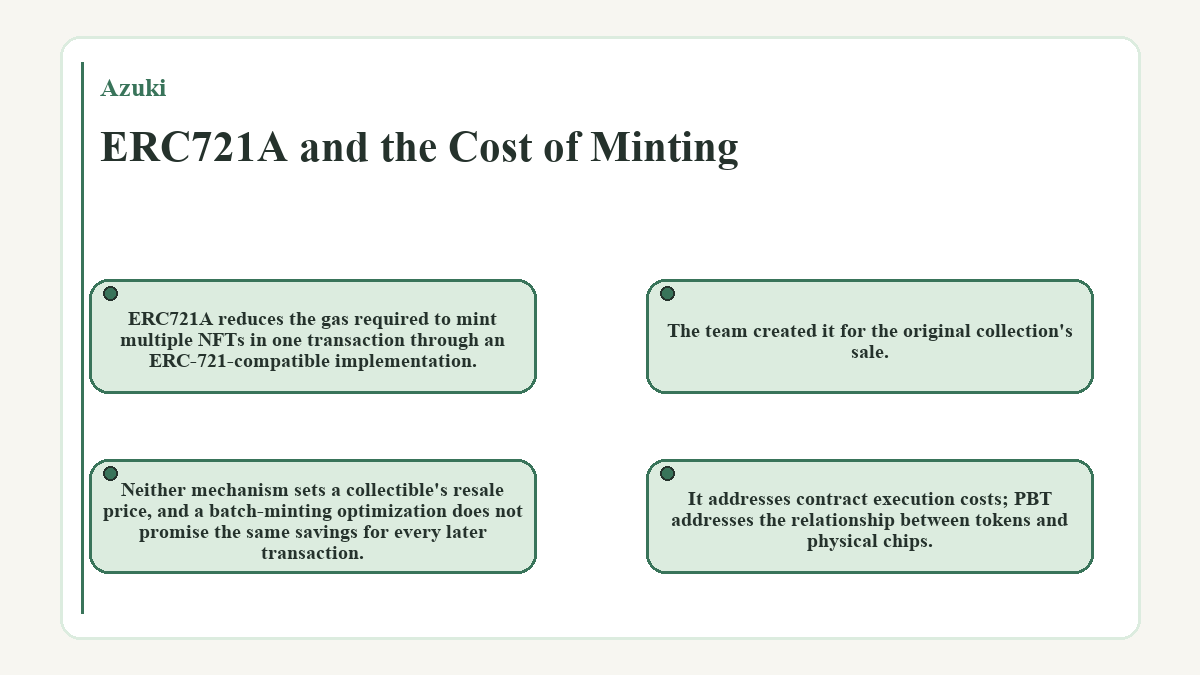
ERC721A reduces the gas required to mint multiple NFTs in one transaction through an ERC-721-compatible implementation. The team created it for the original collection's sale. It addresses contract execution costs; PBT addresses the relationship between tokens and physical chips. Neither mechanism sets a collectible's resale price, and a batch-minting optimization does not promise the same savings for every later transaction.
Digital Collecting, Redemption, and Physical Possession
Digital NFTs, merchandise redemption, and PBT solve different collecting tasks.
A digital collectible centers on a token and its associated artwork. A merchandise redemption centers on eligibility for a physical delivery under a particular offer. A chip-linked collectible adds an ongoing connection between hardware access and token management. An old redemption announcement does not establish that a new buyer can claim another item.
Even products described as PBT can implement different arrangements. The Elements of Time watch collaboration uses a serialized warranty card for minting. Its published product information also permits selling the watch separately from its token. The location of the scan mechanism and the transfer rules therefore belong to the individual product, rather than a universal promise about embedded chips.
Before committing to a collectible, establish whether the purchase includes a digital token, a physical item, or both. Where physical possession matters, retain the associated card or working chip with the item. A token purchase alone does not arrange delivery, and physical delivery alone does not necessarily update the token's owner.
Practical questions about Azuki
Can Someone Copy the Artwork Without Owning the NFT?
Someone can copy an image without acquiring its associated token. The NFT contract records ownership separately from the displayed artwork. Matching images therefore do not establish matching ownership. A collection name can also appear in another contract, which is why the contract address and token identifier distinguish the actual asset.
Why Does an Ethereum NFT Transaction Require Gas?
Gas pays for the computation that Ethereum performs when processing a transaction. Minting or transferring a token changes blockchain state and consumes gas. The transaction's execution requirements and applicable network fees determine that cost, separately from any purchase payment. A transaction that executes and then fails can still consume gas.
Does a Wallet Display Prove That the NFT Artwork Is Stored on Ethereum?
A wallet display does not establish where the artwork is stored. ERC-721 supports metadata that can point to information outside the token contract. The ownership record and the availability of the image are separate properties. An image-loading failure therefore does not, by itself, establish a change in token ownership.
What Happens If a PBT Chip Signature Expires?
A contract that enforces signature freshness rejects a signature outside its permitted window. Completing the operation then requires a fresh signature that satisfies that deployment's rules. PBT's timestamp-based reference implementation includes an expiry check, but its configurable window does not establish one universal time limit for every collectible.
Is PBT Ownership Private?
PBT ownership records on Ethereum are public blockchain data. The token record exposes a wallet address rather than automatically supplying a person's name. However, publishing an association between that address and an identity can make the collectible's ownership easier to attribute. The physical connection does not make the token registry private.
Who Can Build Products Using PBT?
Developers can build on PBT's open-source technology under its MIT License. A working product still needs suitable hardware, a contract that recognizes its chips, and an application that handles the required signatures. Access to the code does not supply those components or make a new product part of the Azuki brand.
· updated